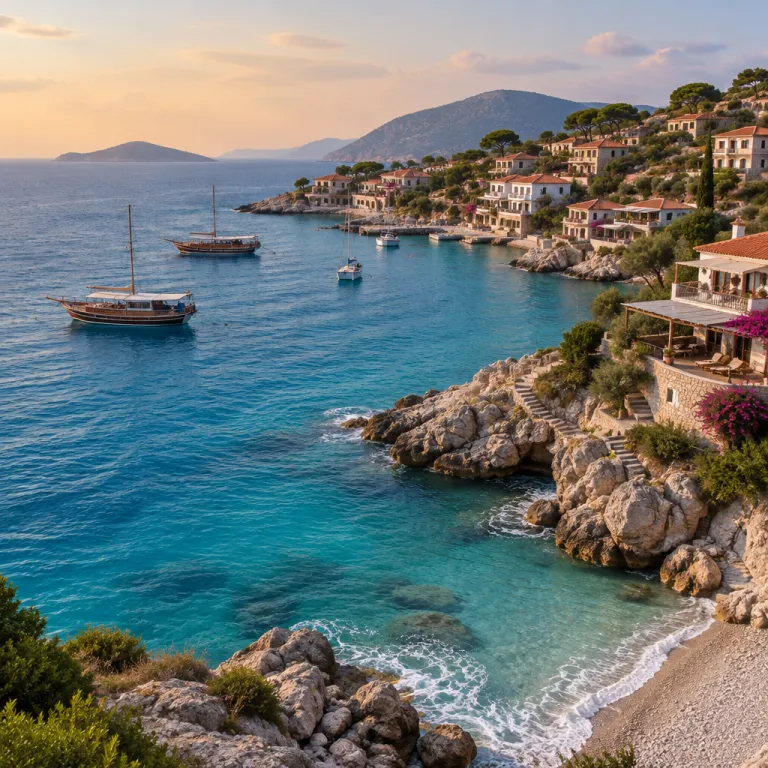
The stretch of the Turkish coast between Kas and Kalkan
On the map of the Turkish coast, the run between Kas and Kalkan looks modest, yet it quietly answers the question of where to stay on the turquoise coast in Turkey for travelers who want character. This is the section of the Turkish Riviera where the mountains fall straight into the sea, where each town curls around its own bay and where the water glows that unmistakable shade of Turkey turquoise in late afternoon. If you are asking yourself where to stay on the turquoise coast Turkey for a romantic escape rather than a mega resort, this is the stretch that keeps coming up in quiet conversations between frequent visitors.
Kas is the working town in this trio, a small city by local standards, with a harbor full of gulets and diving boats rather than cruise ships, and a grid of streets that still feels lived in outside the summer season. Kalkan, by contrast, climbs steeply above the sea in whitewashed terraces, its hotels and villas angled for maximum sunset over the bay and the open Mediterranean. Between and beyond them, smaller villages and coves along the Turkish coast offer a more rural answer to where to stay on the turquoise coast Turkey, with stone houses, a single beach club and a jetty for boat trips.
What unites Kas, Kalkan and their neighboring villages is the water first mentality, because here the sea is not a backdrop but the main event. The coastline is rocky rather than lined with endless sandy beaches, so many hotels build elegant platforms over the water, creating private beach access without disturbing the clarity of the turquoise coast. For couples deciding where to stay, this means choosing between a hotel in town with easy access to restaurants and boat trips, or a quieter resort on a headland where the only sounds at night are waves and the occasional call from the harbor.
Kas: bohemian harbor town with serious sea access
Kas sits roughly halfway between Fethiye and Antalya on the southern Turkish coast, and it feels like a place that has grown organically from the harbor up the hillside rather than being planned as a resort. Cobbled streets run back from the sea, lined with cafés, low key bars and small hotels that make Kas one of the best answers to where to stay on the turquoise coast Turkey if you want atmosphere. The town’s position on a natural bay means the sea is usually calm, with boat trips leaving daily for nearby coves, the sunken ancient city at Kekova and even the edge of a Greek island just across the water.
There are no long sandy beaches in the center of Kas, but there are several beach club platforms and small pebble beaches where the water is glass clear and deep enough for diving straight from the rocks. Many hotels here solve the lack of wide beaches by creating a private beach deck, with ladders into the sea and shaded daybeds that feel more exclusive than a crowded strip of sand. For couples who like to swim, snorkel and then walk straight into town for dinner, Kas offers a very good balance between sea focused days and lively evenings in a compact, walkable town.
Access is part of the story, because Kas is reached by a scenic coastal road from Dalaman Airport to the west or Antalya Airport to the east, each drive taking several hours along the Turkish Riviera. That distance from a major city and from the big resort belts around Antalya keeps Kas quieter and more intimate, especially outside peak summer. If you enjoy the theatrical coastal energy of larger resorts such as the dramatic property reviewed in the guide to Belek’s most theatrical coastal retreat, Kas will feel like the relaxed, bohemian counterpoint where the focus is the harbor, the sea and the slow rhythm of the town.
Kalkan: whitewashed hillsides and polished comfort
If Kas is the bohemian harbor, Kalkan is the polished hillside town where every terrace seems designed for a sunset drink over the bay. Built on a steep slope above a natural harbor, Kalkan has become one of the best known answers to where to stay on the turquoise coast Turkey for couples who like a little glamour with their sea views. The town’s hotels and villas climb high above the water, so even a modest hotel can offer a sweeping view of the bay, the open sea and the rugged Turkish coast beyond.
Down at water level, Kalkan’s shoreline is a mix of small pebble beaches and carefully designed platforms that function as beach clubs, with waiter service, loungers and steps into the sea. Many of the area’s most sought after hotels sit on the headlands around the bay, each with its own private beach deck or jetty, which turns a simple swim into a quietly luxurious ritual. For couples deciding where to stay, Kalkan’s appeal lies in this combination of easy sea access, a compact town center with excellent restaurants and a sense that the entire place has been tuned for long, late Mediterranean evenings.
Kalkan also works well as a base for exploring the wider Turkish Riviera, because day trips from here reach Patara’s vast sandy beaches, the ancient city of Xanthos and the dramatic gorge at Saklikent. Boat trips from the harbor can take you along the coast to quieter coves, or further out into the open sea where the water deepens to a darker shade of Turkey turquoise. If your idea of a good stay is a stylish hotel with a sea facing pool, a short walk into town and the option of a private boat for the day, Kalkan answers the question of where to stay on the turquoise coast Turkey with confidence.
The villages and bays between Kas and Kalkan
Between Kas and Kalkan, the road threads through smaller villages and hidden bays that offer a different answer to where to stay on the turquoise coast Turkey, one defined by quiet and proximity to the water. Places like Çukurbağ Peninsula near Kas or the coves around Kalamar Bay and Kisla near Kalkan are lined with low rise hotels and villas that step down towards the sea. Here, the focus is less on town life and more on waking up to the sound of waves, swimming before breakfast and watching the light move across the bay all day.
Many of these coastal properties have been designed around the idea of a private beach experience, even when the shoreline itself is rocky rather than sandy. Platforms, jetties and stone terraces create direct access to the sea, often with ladders into deep, clear water that feels like a natural infinity pool. For couples who care more about uninterrupted sea views and quiet nights than about being in the center of a town, these villages can be the best places to stay on this part of the Turkish coast.
Staying in one of these bays also changes how you move along the coast, because you are more likely to use boat trips as your main form of exploration rather than driving between towns. From a hotel on a headland you can arrange a day at sea, stopping at coves only reachable from the water and swimming in parts of the turquoise coast that remain empty even in high season. If you are interested in how this quieter, design focused approach plays out further north on the Aegean Sea, the guide to hidden design hotels between Çanakkale and Kuşadası offers a useful comparison with the more intimate bays between Kas and Kalkan.
Sea days, boat culture and coastal history
Life along this section of the Turkish Riviera is organized around the sea, and any serious answer to where to stay on the turquoise coast Turkey has to start with how you want to spend your days on the water. In Kas, diving is a major draw, with several reputable schools offering trips to reefs, wrecks and underwater canyons in the clear waters of the Mediterranean. Kalkan leans more towards leisurely boat trips, with gulets and smaller boats heading out daily to swim stops, lunch at sea and long, lazy afternoons anchored in quiet bays.
From both towns, one of the most compelling excursions is to the sunken ancient city at Kekova, where boat captains glide slowly over submerged walls and harbors that slipped beneath the sea after earthquakes. The contrast between the ruins and the luminous Turkey turquoise water is striking, and it underlines how closely history and the sea are intertwined along this coast. On land, short drives from Kas and Kalkan bring you to Lycian Way hiking sections, hillside tombs and the remains of ancient cities that once controlled trade routes along what is now the modern Turkish coast.
There is also a subtle island culture here, because the Greek island of Kastellorizo sits just offshore from Kas, its pastel harbor visible on clear days and reachable by a short ferry ride. That proximity adds another layer to the question of where to stay on the turquoise coast Turkey, especially for travelers who enjoy combining different cultures within a single trip. You might spend several nights in a hotel above the harbor in Kas, take a day to wander Kastellorizo’s waterfront and then return to the Turkish side for dinner in town, with the lights of the island flickering across the water.
Getting there, seasons and how this coast compares
Reaching Kas and Kalkan requires a little more planning than flying into a major resort city, and that friction is part of why this stretch of the Turkish coast remains relatively calm. Most travelers arrive via Dalaman Airport, then drive around two and a half hours along the coast towards Fethiye and beyond, or via Antalya Airport with a similar journey from the opposite direction. Izmir Airport is technically another gateway to the Aegean Sea, but for this particular section of the turquoise coast it is too far to be practical for a short stay.
Once you arrive, the question of when to stay becomes as important as where to stay on the turquoise coast Turkey, especially for couples seeking quieter beaches and softer light. High summer brings heat, energy and full beach clubs, but many repeat visitors quietly favor late September and October, when the sea is still warm, the crowds have thinned and hotel rates often ease. This autumn window suits travelers who want to swim daily, enjoy long lunches by the sea and still have enough daylight for boat trips and visits to nearby historic sites without the intensity of peak season.
In terms of comparison, Kas and Kalkan sit in a different register from larger destinations such as Bodrum or the resort belts near Antalya, which offer more nightlife, bigger hotels and easier access from a major city. If you want a high energy beach club scene, extensive shopping and large scale resorts, those areas may be a better fit than the quieter bays between Kas and Kalkan. For couples who prioritize sea clarity, characterful towns and a sense of being slightly removed from the main flow, this section of the Turkish Riviera remains one of the best answers to where to stay on the turquoise coast Turkey.
Who this coast suits, and how to choose your base
Choosing where to stay on the turquoise coast Turkey between Kas, Kalkan and the surrounding villages comes down to how you like to balance pulse and peace. Kas suits couples who want a town with a lived in feel, a working harbor and evenings that stretch from meze to late night drinks without ever feeling staged. Kalkan appeals to travelers who enjoy polished comfort, sea facing hotels and a dining scene that has grown to match the expectations of an international, style conscious crowd.
The smaller bays and peninsulas between and around the two towns are ideal for couples who want to wake up close to the water and are happy to drive or take a taxi into town when they want more buzz. In these spots, the hotel becomes your main world, with a private beach deck, a pool and perhaps a small jetty for boat trips along the coast. For many guests, this is the most luxurious way to experience the Turkish Riviera, because the days fall into a simple rhythm of swimming, reading, long lunches and watching the light change over the sea.
It is also worth thinking about how this coastal stay fits into a wider journey through Turkey, especially if you are combining the turquoise coast with time in Istanbul or the Aegean. A few nights in a characterful property beside Hagia Sophia, such as the one reviewed in the guide to an intimate stay beside Hagia Sophia, pairs naturally with a week split between Kas and Kalkan. That combination gives you the layered history of the city and the sea focused calm of the coast, which together answer not only where to stay on the turquoise coast Turkey, but how to shape a trip through the country that feels balanced and complete.
Key figures on travel to the Turquoise Coast
- According to Türkiye’s Ministry of Culture and Tourism, Antalya Province receives over 30 percent of all international visitors to Turkey, underlining the importance of the wider Turkish Riviera as a gateway to the turquoise coast.
- Official tourism data shows that Dalaman Airport handles more than 5 million passengers annually, with a significant share traveling onward to coastal towns such as Fethiye, Kas and Kalkan along the Mediterranean coast.
- Surveys by regional tourism boards indicate that repeat visitation rates to smaller coastal towns on the Turkish coast, including Kas and Kalkan, exceed 40 percent, reflecting strong loyalty among travelers who value quieter, sea focused stays.
- Climate records from the Turkish State Meteorological Service show average sea temperatures along this stretch of coast remain above 23 °C into October, supporting the case for late season travel when crowds are thinner.
FAQ about where to stay on the Turquoise Coast
Is Kas or Kalkan better for a first stay on the Turquoise Coast ?
Kas is better if you want a more local town feel, with a working harbor, diving culture and a slightly younger, bohemian crowd. Kalkan suits travelers who prefer polished hotels, strong restaurant options and hillside views over a sheltered bay. Both are good bases, so your choice depends on whether you value town atmosphere or refined comfort more.
How many days should couples spend between Kas and Kalkan ?
For a first trip, many couples find that seven to ten nights split between Kas and Kalkan works well, with three or four nights in each town. That allows time for boat trips, relaxed beach days and visits to nearby historic sites without rushing. If you plan to include longer drives or hiking sections of the Lycian Way, consider adding several extra nights.
Which airport is best for reaching Kas and Kalkan on the Turkish coast ?
Dalaman Airport is usually the most convenient for both Kas and Kalkan, with a coastal drive of around two and a half hours to each town. Antalya Airport is a viable alternative, especially if you plan to combine this trip with time in larger resorts further east. Izmir Airport is generally too far for a short stay focused only on the Kas and Kalkan area.
Are there sandy beaches near Kas and Kalkan, or mainly rocky platforms ?
The immediate coast around Kas and Kalkan is mostly rocky, with pebble coves and man made platforms that offer direct access to deep, clear water. For wide sandy beaches, many travelers take day trips to Patara or Kaputaş, both reachable by car or organized excursion. This mix lets you enjoy both dramatic rocky bays and classic sandy beaches during a single stay.
When is the best season for couples to visit the Turquoise Coast in Turkey ?
Late spring and early autumn are often considered the best seasons for couples, because the sea is warm, the light is soft and the towns are lively without being crowded. July and August bring higher temperatures and more visitors, which some travelers enjoy for the energy and full beach clubs. If you value quieter evenings and easier restaurant reservations, aim for May, June, late September or October.